Hue and Chiang Rai for Culture Lovers: Asia's Underappreciated Destinations This Spring
"Thành Huế ngàn năm — the thousand-year imperial capital." This old Vietnamese saying captures what makes Hue extraordinary, yet somehow, it remains overshadowed by Ha Long Bay and Ho Chi Minh City. Meanwhile, thousands of kilometres west in Northern Thailand, Chiang Rai has quietly developed into one of Asia's most compelling art and culture destinations, yet continues to play second fiddle to nearby Chiang Mai.
While travellers crowd into Hanoi, Bangkok, Phuket, and Singapore this spring, a growing movement of culture-seekers is choosing depth over density, authenticity over Instagram moments. Vietnam's 2026 tourism momentum emphasises deeper, more authentic experiences away from overcrowded tourist hubs, and Northern Thailand's wellness and cultural tourism is experiencing a record spring season focused on meaningful connections rather than rapid consumption. This spring presents the perfect window to explore two of Asia's most culturally rich yet underappreciated destinations: Hue in Central Vietnam and Chiang Rai in Northern Thailand.
If you're the sort of traveller who prefers wandering through ancient courtyards to elbowing through tourist crowds, who values a three-hour conversation with a local artisan over ticking off landmarks, then these two imperial and artistic heartlands deserve your attention this spring.
What makes Hue and Chiang Rai special for cultural explorers
Hue: Vietnam's living museum of imperial heritage
Hue is targeting 7.5 million tourist arrivals in 2026, positioning itself as a heritage-ecological-landscape city. The former imperial capital of Vietnam's Nguyen Dynasty (1802-1945) is not merely a collection of monuments frozen in time. Along the Perfume River, the Imperial City's solemn palaces and ancient royal tombs stand as witnesses to centuries of Vietnamese history. Recent investments in heritage sites including the imperial monuments of Hue and cave systems of Central Vietnam reflect Vietnam's emphasis on cultural immersion and low-impact adventure.
What sets Hue apart from other heritage cities is its commitment to living culture. The Hue Festival 2026 will be organised throughout the four seasons with diverse cultural and artistic activities, turning the city into a year-round cultural celebration rather than a single-event destination. This approach allows visitors to experience imperial traditions through royal court music performances, traditional craft demonstrations at Thanh Toan Village, and the evening atmosphere along Huong River where contemporary Vietnamese life unfolds against a backdrop of centuries-old architecture.
The city has embraced digital transformation whilst preserving authenticity. Hue has launched cultural-heritage-technology experience spaces, multilingual audio guides, and AI-supported services that particularly appeal to younger visitors. You can now use the Hue City Passport for streamlined access to heritage sites, yet still find artisans hand-weaving silk in traditional workshops unchanged for generations.
Chiang Rai: Thailand's contemporary art meets ancient Lanna culture
Whilst Chiang Mai draws the wellness crowd and digital nomads, Chiang Rai rewards those willing to look closely, unfolding at its own pace through quiet temple courtyards and mist-covered hills. This northern Thai city has cultivated something rare in Southeast Asian tourism: a distinctive identity that doesn't attempt to replicate larger destinations but instead focuses on architectural innovation, artistic depth, and regional Lanna cultural heritage.
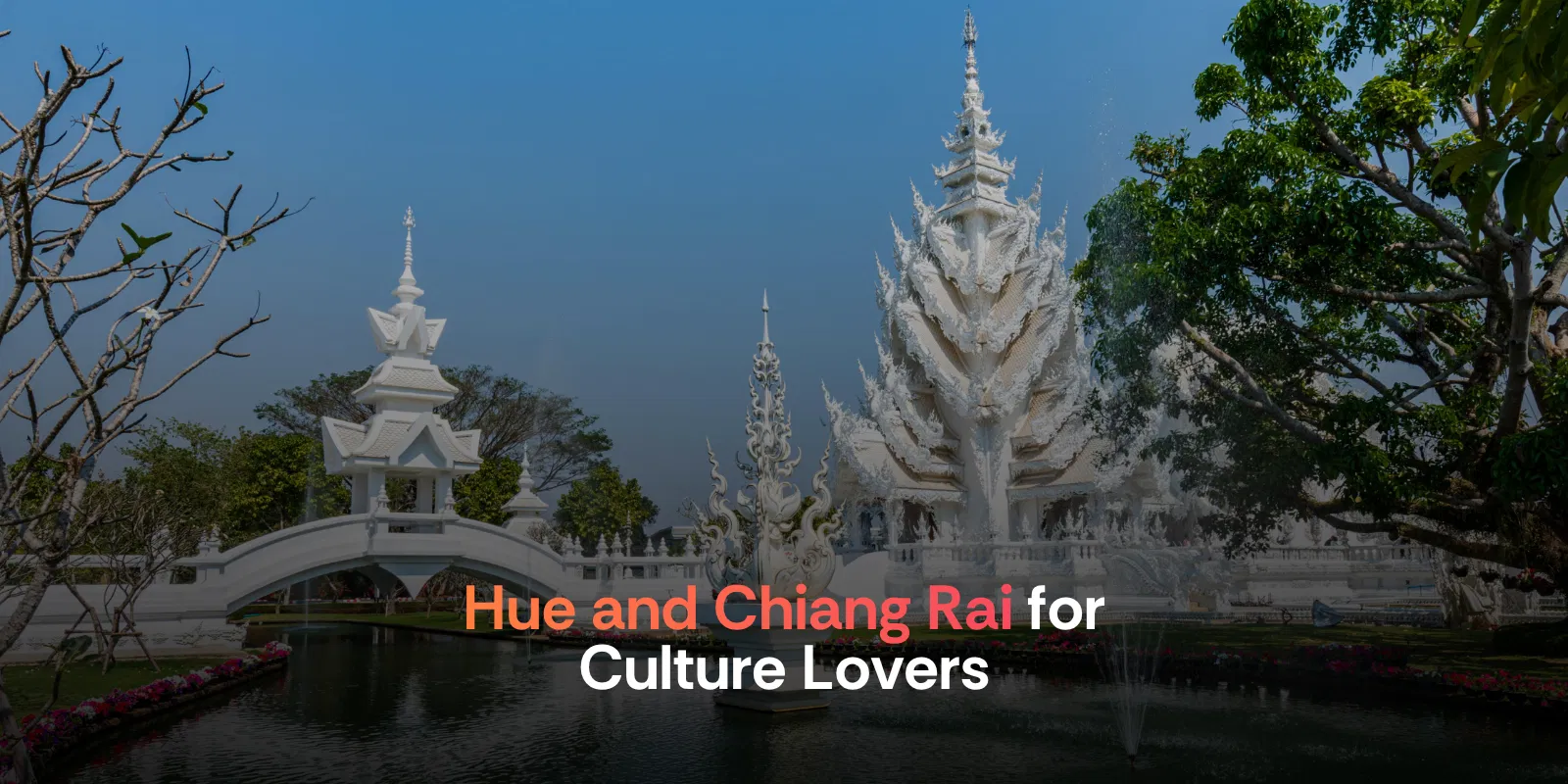
The city is globally recognised for its stunning Buddhist architecture that bridges tradition and contemporary expression. Wat Rong Khun's white facade catches light so sharply it feels sculpted from glass, whilst Wat Rong Suea Ten's deep sapphire interiors create immersive spaces. At Baan Dam Museum, the dark teak structures present philosophical art installations that invite contemplation rather than quick photographs.
Chiang Rai has become part of Northern Thailand's Green Revolution focused on wellness seekers and nature lovers, with advanced smog-free hospitality initiatives making 2026 a record year for spring travel. The city balances spiritual heritage with environmental innovation, positioning itself perfectly for travellers seeking cultural depth with contemporary comfort.
Why spring 2026 is the perfect time to visit
Spring travel in 2026 brings unique advantages to both destinations. Hue's springtime months from February through April show the historic capital in its best light with ideal temperatures, whilst Chiang Rai's improved air quality through smog-free initiatives makes spring 2026 particularly attractive.
Thailand has been named the world's top destination for April 2026, with Songkran playing a central role, whilst Chiang Rai develops its Three Nations Songkran identity at Chiang Saen where Thailand, Laos, and Myanmar borders meet. This creates a unique cultural moment for visitors who can experience both Vietnamese imperial traditions during Hue Festival and Northern Thai water festival celebrations within the same journey.
The current travel landscape favours these destinations. Anti-tourism travel is rising, with searches for accommodation in secondary Asian destinations growing more than 15 per cent faster than traditional tourist hubs. Both Hue and Chiang Rai benefit from this shift, offering the infrastructure and cultural depth of major destinations without the overwhelming crowds.
Location and accessibility: Reaching these cultural heartlands
Getting to Hue, Central Vietnam
Hue sits in Central Vietnam, approximately midway between Hanoi and Ho Chi Minh City. Phu Bai International Airport serves domestic flights from Hanoi and Ho Chi Minh City, located 30 minutes from the city centre. International travellers typically fly into Da Nang International Airport (two hours south) which offers direct connections from major Asian hubs including Singapore, Bangkok, Seoul, and increasingly from Indian cities.
The scenic train journey along the Reunification Express line has gained popularity. Luxury and experiential trains operating along the north-south corridor offer multi-day journeys combining on-board gastronomy with off-train excursions to villages, markets, and coastal landscapes. For those travelling between destinations, high-quality bus services and private car hire from Da Nang provide flexibility.
Flight options for Indian travellers: Major Indian cities including Delhi, Mumbai, and Bangalore offer connections to Da Nang via Bangkok, Singapore, or Kuala Lumpur. Approximate flight times range from 6-8 hours including layovers. Vietnam offers e-visa facilities for Indian passport holders, typically processed within three business days (verify current requirements via official channels).
Getting to Chiang Rai, Northern Thailand
Chiang Rai Mae Fah Luang International Airport serves direct flights from Bangkok (1 hour 30 minutes), with increasing regional connectivity from Singapore, Kuala Lumpur, and Chengdu. Routes from Chiang Mai to Chiang Rai are available with affordable, reliable options starting at just $12 (approximately €11 or ₹1,000), enhancing accessibility to the Golden Triangle and White Temple.
Travellers are increasingly coming across the border from Laos or flying from nearby Asian hubs like Singapore and Hong Kong to reach Chiang Rai. The Mekong River border crossing adds adventure for those combining Laos and Thailand in one journey.
Flight options for Indian travellers: Indian cities connect to Chiang Rai via Bangkok or Singapore. Delhi-Chiang Rai typically takes 6-7 hours with one connection. Thailand's visa-free entry for Indian passport holders (typically 15-30 days, verify current policy) makes border formalities straightforward.
Currency note: Throughout this guide, prices are indicated in Euros (€) for global travellers. As of April 2026, approximate exchange rates are €1 = ₹92 (Indian Rupee), €1 = 38 Thai Baht, and €1 = 26,500 Vietnamese Dong. Always verify current rates before travelling, as exchange rates fluctuate.
What to see, do, and experience in Hue
The Imperial City and royal tombs
The Complex of Hue Monuments, a UNESCO World Heritage Site, forms the heart of any cultural visit. The Complex of Hue Monuments remains Hue's most popular attraction, with ticket sales reaching a record 473 billion VND in 2025 despite temporary closures from flooding. The walled Citadel encompasses the Forbidden Purple City, where only emperors, their families, and eunuchs once walked. Restoration work continues carefully, balancing preservation with accessibility.
Beyond the main Citadel, the royal tombs scattered along the Perfume River present distinct architectural visions. Each emperor designed his own resting place: Minh Mang's tomb showcases symmetrical grandeur with lotus ponds and pavilions, whilst Khai Dinh's mausoleum blends Vietnamese and European Art Deco styles with elaborate mosaic work. Tu Duc's tomb functions as a romantic landscape garden with a lake, fishing pavilion, and poetry inscriptions carved into stone.
Entry fees and timings: Imperial City admission costs approximately €5 per person, with combined tickets for multiple royal tombs around €8-12. Sites typically open 7:00 AM to 5:30 PM. Early morning visits between 7:00-9:00 AM offer cooler temperatures and thinner crowds (prices verified as of April 2026; always check official venue sites for latest details).
| Heritage Site | Approximate Entry Fee | Time Needed | Best Time to Visit |
|---|---|---|---|
| Imperial City (Citadel) | €5 | 2-3 hours | 7:00-9:00 AM |
| Minh Mang Tomb | €3 | 1.5 hours | Early morning or late afternoon |
| Khai Dinh Tomb | €3 | 1 hour | Morning before 10:00 AM |
| Tu Duc Tomb | €3 | 1.5-2 hours | 8:00-10:00 AM or 3:00-5:00 PM |
Perfume River experiences and local life
The Huong River defines Hue's character, separating the ancient Citadel from residential neighbourhoods. Hue's riverside experiences now include vibrant night-time attractions along the Huong River. Evening boat cruises feature traditional royal court music performances, though the real magic happens simply drifting past illuminated pagodas whilst locals gather at riverside cafés.
Cross Truong Tien Bridge at sunset when golden light bathes French colonial architecture. The neighbourhoods beyond host family-run restaurants where you'll find bún bò Huế (spicy beef noodle soup) prepared according to generations-old recipes. Dong Ba Market reveals daily life: vendors sell everything from conical hats to medicinal herbs, whilst upstairs, textile merchants display traditional áo dài fabrics.
Thuy Xuan Incense Village, 10 kilometres from the city centre, presents traditional incense-making as a living craft. Families dry multicoloured incense sticks in their courtyards, creating visually striking scenes that photographers cherish. Visitors can participate in workshops, learning to roll incense by hand using natural materials.
Hue's distinctive royal cuisine
Hue cuisine reflects its imperial past, with dishes originally designed for royal banquets now enjoyed by everyone. Bún bò Huế, the city's signature dish, balances spicy, salty, and slightly sweet flavours in a beef broth enhanced with lemongrass. Small restaurants near Dong Ba Market serve it best, often alongside nem lụi (grilled pork skewers wrapped in rice paper).
Bánh khoái (Hue-style pancakes) differ from southern bánh xèo, prepared smaller and thicker, stuffed with shrimp and pork. Street vendors near the Citadel prepare them fresh. For something unusual, try cơm hến (baby clam rice), a humble dish mixing rice, clams, peanuts, pork crackling, and fresh herbs.
The royal tradition of elaborate presentation continues in restaurants along Hung Vuong Street, where multi-course meals arrive on decorated platters. Whilst not cheap (€15-25 per person for royal banquet experiences), these dinners demonstrate culinary artistry unique to Hue.
What to see, do, and experience in Chiang Rai
The temple circuit: White, Blue, and Black
Wat Rong Khun (White Temple) stands out for its pristine white chapel and intricate stuccowork created by National Artist Chalermchai Kositpipat. The first sight of Wat Rong Khun is almost disorienting, its white facade catching light so sharply it feels sculpted from glass rather than plaster. Inside, murals blend traditional Buddhist imagery with contemporary pop culture references – spotting figures from The Matrix and superhero films amongst religious scenes creates a surreal experience. The temple sits 13 kilometres south of central Chiang Rai (entry €1.60, approximately ₹150).
Wat Rong Suea Ten (Blue Temple) presents an entirely different aesthetic. The deep sapphire interiors feel immersive without being overwhelming, with elaborate gold leaf detailing and a striking white Buddha statue. Located within the city, it's easily reached by tuk-tuk or bicycle (free entry, donations welcome).
Baan Dam Museum (Black House) showcases the late artist Thawan Duchanee's philosophical vision through 40 dark teak structures displaying collections from around the world. At Baan Dam Museum, the dark teak structures and stark installations create a mood that is contemplative rather than decorative. The space challenges visitors to contemplate mortality, spirituality, and artistic expression. Located 10 kilometres north of Chiang Rai (entry €2.50, approximately ₹230).
Golden Triangle and border culture
The Golden Triangle Park marks where the borders of Thailand, Laos, and Myanmar converge at the Ruak and Mekong rivers, once a hub of international opium trade, now offering a peaceful atmosphere with rich history. The Hall of Opium Museum presents the region's complicated past through interactive exhibits and historical artefacts, providing context that simple viewpoint visits miss (entry €5).
Long-tail boat trips along the Mekong offer perspectives on three countries within an hour. Vendors at the river junction sell Laotian textiles and Burmese lacquerware, though bargaining is expected. For deeper immersion, consider homestays in Chiang Saen, the old border city developing its Three Nations Songkran identity, where Mekong riverside guesthouses provide quiet bases for exploring ancient temple ruins and market culture.
Lanna culture and hill tribe communities
Beyond headline attractions, Chiang Rai's cultural texture lies in craft communities where textiles are woven by hand, ceramics shaped on spinning wheels, and silver jewellery etched using techniques passed through generations. These working spaces welcome respectful visitors interested in traditional crafts.
The Chiang Rai Night Bazaar supports local commerce and crafts, whilst the Baan Dam Museum reinforces the city's cultural depth through commercial and artistic spaces. Evening visits reveal a different character, with food stalls offering khao soi (Northern Thai curry noodles) and sai ua (Lanna-style sausage).
Hill tribe villages near Chiang Rai, including Karen and Akha communities, present opportunities for cultural exchange when approached thoughtfully. Community-based tourism initiatives ensure benefits reach local families directly. Select operators offering multi-day treks that include homestays, traditional meals, and craft workshops over rushed day trips (typically €40-60 per day including accommodation, meals, and guide).
Doi Tung Royal Villa and gardens
Doi Tung Palace serves as a mountain retreat with stunning gardens, tea and coffee plantations, and a royal project dedicated to uplifting hill tribes. The late Princess Mother's vision transformed this region from opium cultivation to sustainable agriculture, with profits supporting local communities. The beautifully maintained gardens showcase temperate flowers unusual in tropical Thailand, whilst the villa itself presents Lanna architecture with Swiss chalet influences.
Adjacent Mae Fah Luang Art and Culture Park displays hill tribe artefacts and traditional Lanna art forms. Combined entry for the villa and gardens costs approximately €5. The site sits at 1,200 metres elevation, offering cooler temperatures and mountain views (1.5-2 hours needed, best visited mid-morning).
Insider travel tips: Making the most of cultural immersion
Hue practical wisdom
Timing visits: Hue can experience flooding from October through late in the year, making spring (February-April) significantly better for exploration. Early mornings at heritage sites beat both heat and crowds – aim for 7:00-9:00 AM arrivals.
Getting around: Within the city centre, walking and hired bicycles work well. For royal tombs along the Perfume River, hire a motorbike (€5-7 per day) or arrange a car and driver (€25-35 for a full-day tomb circuit). Apps like Grab function reliably for shorter trips.
Cultural sensitivity: The Imperial City remains a sacred site for many Vietnamese. Dress modestly (covered shoulders and knees), remove shoes before entering temple buildings, and speak quietly in ceremonial spaces. Photography is permitted in most areas but avoid flash near artefacts.
Language: English proficiency varies. Download Google Translate's offline Vietnamese pack. Basic phrases like "Xin chào" (hello), "Cảm ơn" (thank you), and "Bao nhiêu tiền?" (how much?) go far in showing respect.
Chiang Rai practical wisdom
Transport strategy: Travelers are now staying in Northern Thailand for an average of 10-14 days to fully immerse in the slow life, with Thailand's high-speed train network transforming travel between cities. Rent a motorbike (€7-10 per day) for flexibility visiting temples and villages. Within the city, rot daeng (red trucks functioning as shared taxis) cost €0.50-1.00 per person for standard routes.
Temple etiquette: Remove shoes before entering temple buildings. Dress modestly – no shorts above knees or sleeveless tops. Women should not touch monks or hand items directly to them. Speak softly and avoid pointing feet at Buddha images.
Craft purchases: When buying directly from artisans, respectful bargaining is normal at markets but not in workshop showrooms displaying fixed prices. Quality hill tribe textiles, particularly Akha embroidery and Karen woven bags, make meaningful souvenirs (€15-50 depending on size and intricacy).
Best times: 2026 marks a record year for spring travel in Northern Thailand with improved air quality through smog-free hospitality initiatives. Arrive in morning at Wat Rong Khun (8:00-9:00 AM) before tour groups, and save Blue Temple for late afternoon when golden light enhances the blue facade.
Nearby attractions and day trips
From Hue: Phong Nha-Ke Bang National Park
Three hours north of Hue, Phong Nha-Ke Bang cave systems in Central Vietnam have attracted international media attention as part of Vietnam's emphasis on cultural and ecological tourism. The national park contains some of the world's largest cave systems, including Son Doong Cave (world's largest). Paradise Cave and Phong Nha Cave offer accessible tours without requiring extreme caving experience.
The riverside town of Phong Nha has developed sustainable tourism infrastructure, with family-run guesthouses and restaurants. Multi-day trips combining Hue heritage sites with Phong Nha's natural wonders work well for active travellers (book cave tours in advance during peak season).
From Chiang Rai: Chiang Saen and Mekong experiences
Chiang Saen promotes its Three Nations Songkran identity, with the Mekong old-town experiences and border culture differentiating it from Chiang Mai. Ancient ruins scattered through this quiet riverside town date to the 13th century. The atmosphere contrasts sharply with modern Chiang Rai – water buffalo graze near temple compounds, and river life unfolds at a contemplative pace.
Hire a bicycle in Chiang Saen and explore temple ruins along quiet lanes (1-2 days recommended). The town serves as a base for Golden Triangle exploration without tourist-zone commercialisation.
Photography and travel documentation
Capturing Hue's imperial atmosphere
The Citadel's layered architecture photographs beautifully in morning's soft light when mist sometimes rises from the moat. Position yourself at Ngo Mon Gate (Noon Gate) before 8:00 AM for images without crowds. The Perfume River at sunset offers classic compositions, particularly from Truong Tien Bridge with the Citadel's red walls behind.
For more intimate shots, explore residential neighbourhoods around Dong Ba Market where colonial architecture frames daily life. Thuy Xuan Incense Village becomes magical mid-morning when sunlight backlights coloured incense sticks drying in courtyards. Always ask permission before photographing people, especially at artisan workshops.
Photographing Chiang Rai's temples
Wat Rong Khun's white facade catches light so sharply that morning or late afternoon shots work better than harsh midday sun. The "bridge of rebirth" over desperate reaching hands creates striking images. Photography is permitted throughout the temple grounds, though tripods may be restricted inside the main hall.
Blue Temple photographs best in golden hour (4:00-5:30 PM) when warm light contrasts with cobalt blue walls. The interior's gold detailing requires camera settings that handle high contrast well. Baan Dam Museum's dark structures work photographically in any light but consider midday for strong shadows that emphasise architectural forms.
For hill tribe portraits, building trust matters more than technical skills. Spend time in communities before requesting photographs, always ask permission, and offer to share digital copies. Some communities request small payments for photos – respect this practice.
Seasonal highlights: Spring 2026 cultural events
The Hue Festival 2026 is organised throughout the four seasons with diverse cultural and artistic activities. Spring programming typically includes traditional court music performances at the Citadel, ao dai fashion shows, poetry readings in royal gardens, and boat racing on the Perfume River. Check the official Hue Festival website for specific dates and ticketed events.
Chiang Saen's Three Nations Songkran in mid-April creates a unique cultural moment where Thai, Lao, and Burmese water festival traditions merge. Beyond the famous water fights, traditional elements include merit-making at temples, sand pagoda building, and blessing ceremonies with elder community members. Songkran 2026 now includes eco-friendly water zones and cultural parades replacing wasteful street fights.
Cost considerations for cultural travel
Hue budget guide
| Category | Budget Range (per day) | Mid-Range | Comfortable |
|---|---|---|---|
| Accommodation | €8-15 | €20-35 | €45-80 |
| Meals | €5-8 | €10-15 | €20-30 |
| Transport | €3-5 | €8-12 | €15-25 |
| Entrance fees | €5-8 | €8-15 | €15-25 |
| Daily Total | €21-36 | €46-77 | €95-160 |
Heritage site tickets, bicycle rentals, and local meals remain very affordable. Mid-range travellers staying in boutique hotels near the Citadel with cultural tours and quality restaurant meals should budget €50-80 daily.
Chiang Rai budget guide
| Category | Budget Range (per day) | Mid-Range | Comfortable |
|---|---|---|---|
| Accommodation | €10-18 | €25-45 | €55-100 |
| Meals | €6-10 | €12-18 | €22-35 |
| Transport | €5-8 | €10-15 | €20-30 |
| Entrance fees | €3-6 | €6-12 | €12-20 |
| Daily Total | €24-42 | €53-90 | €109-185 |
Northern Thailand remains affordable compared to islands or Bangkok. Quality guesthouses, temple visits, local restaurants, and motorbike rentals fit comfortably within mid-range budgets (€55-90 daily).
Planning your cultural journey: Combining both destinations
For travellers wanting to experience both Hue and Chiang Rai, several route options work well:
Option 1: Vietnam to Thailand overland (12-14 days): Fly into Hanoi → Train/bus to Hue (4-5 days) → Continue to Da Nang/Hoi An (2-3 days) → Fly to Bangkok → Travel to Chiang Rai (4-5 days). This route allows gradual cultural immersion through Central Vietnam before transitioning to Northern Thailand.
Option 2: Two-destination focus (10-12 days): Fly into Da Nang → Hue (4-5 days) → Fly to Chiang Rai (5-6 days) → Depart Bangkok. Concentrates time in the two main cultural destinations with minimal transit.
Best season: February through April offers ideal weather in both locations. Hue's springtime shows the historic capital in its best light, whilst Chiang Rai experiences record spring travel conditions in 2026.
If you're also planning to explore Thailand further, consider reading our Thailand Guide for broader itinerary ideas. For those interested in Vietnam's most popular activities, our Best Things to Do in Vietnam guide complements this cultural deep dive perfectly.
Good reads: Planning your Southeast Asian cultural journey
Exploring Southeast Asia's cultural heartlands? Our destination guides help you discover more:
Vietnam experiences: Best Things to Do in Vietnam covers cultural and natural highlights beyond Hue
Thailand insights: Don't Come to Thailand If You Hate… offers honest perspectives on Thai travel
Regional planning: Thailand Travel Guide helps connect Chiang Rai with other destinations
AI trip planning: Plan Your Holiday with Eia – Alike's AI Trip Planner can create custom cultural itineraries combining Vietnam and Thailand
For those continuing to Singapore from Thailand, our Singapore Guide for Family Holidays, Honeymoon & Romantic Breaks presents another Southeast Asian cultural experience.
Why these destinations matter in 2026
The shift toward value-driven tourism emphasising emotional depth, physical wellbeing, and mental fulfilment defines travel in 2026. Hue and Chiang Rai embody this movement – destinations where slowing down enhances experience rather than diminishes it.
Vietnam's 2026 tourism approach emphasises depth rather than speed, with heritage tourism remaining a cornerstone. Thailand's cultural transformation shows visitors now choosing quieter streets, small museums, family-run cafés, and hands-on workshops over rapid landmark consumption.
These cities reward the curious, the patient, and the culturally engaged. They're not places you tick off a list; they're destinations that invite you to settle into a different rhythm, to see how imperial traditions inform daily life, to understand how contemporary art dialogues with ancient spirituality, to taste cuisine that carries centuries of refinement.
The spring months bring these destinations alive. Gardens bloom at Doi Tung. The Perfume River flows full and clear. Festival programming fills evenings with music and performance. The weather sits in that perfect range between winter's chill and summer's intensity.
For culture lovers willing to venture beyond the well-trodden path, Hue and Chiang Rai present Asia at its most authentic, most rewarding, and frankly, most underappreciated. This spring, whilst everyone else crowds into Hanoi or Bangkok, you'll find yourself sipping Vietnamese imperial tea in a garden built for emperors, or contemplating existence in a sapphire temple as incense smoke curls toward elaborately painted ceilings.
That's the sort of travel that stays with you long after the photographs fade – the sort that changes how you see the world. And isn't that precisely why we travel in the first place?
Frequently Asked Questions
What is the best time to visit Hue and Chiang Rai for cultural tourism?
What is the best time to visit Hue and Chiang Rai for cultural tourism?
How many days should I spend in each destination to properly experience the culture?
How many days should I spend in each destination to properly experience the culture?
What is the approximate budget for a cultural trip to Hue and Chiang Rai?
What is the approximate budget for a cultural trip to Hue and Chiang Rai?
Are Hue and Chiang Rai safe destinations for solo travellers and families?
Are Hue and Chiang Rai safe destinations for solo travellers and families?
How do cultural customs differ in Hue versus Chiang Rai, and what should visitors know?
How do cultural customs differ in Hue versus Chiang Rai, and what should visitors know?
What makes Hue and Chiang Rai better choices than more popular destinations like Hanoi or Chiang Mai?
What makes Hue and Chiang Rai better choices than more popular destinations like Hanoi or Chiang Mai?