
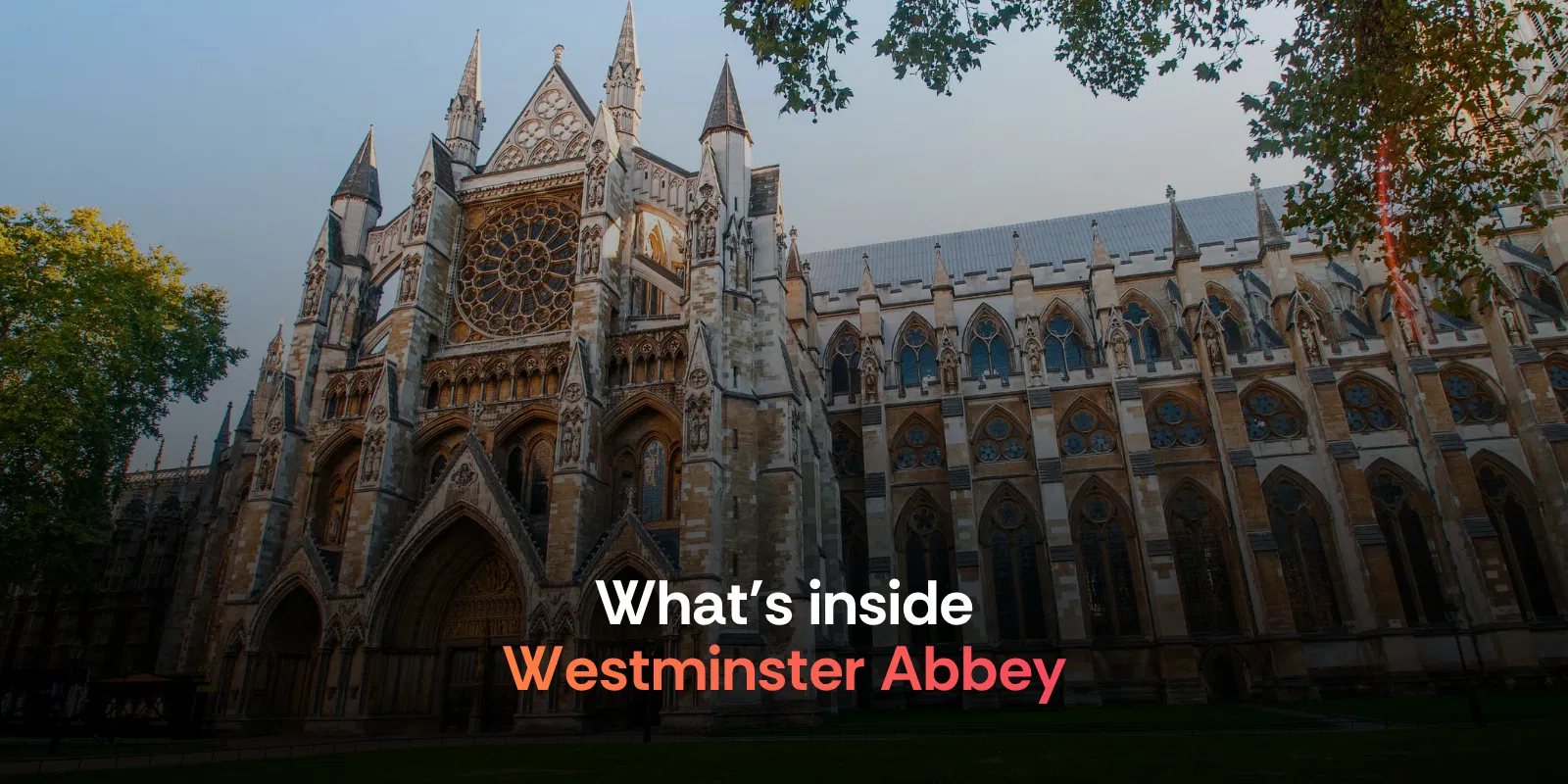
What's Inside Westminster Abbey? A Complete Visitor Guide (2026)
The noise of Parliament Square cuts off the moment you step through the West Door. Inside, the air is cool and carries the faint trace of incense that seems to have soaked into the stone over centuries. Gothic arches climb more than 30 metres above the nave floor, and the walls on every side are covered in tablets, carvings, and effigies marking the burial places of monarchs, poets, scientists, and soldiers. Westminster Abbey has been accumulating history since 960 AD, and a visit here is less like touring a building and more like reading a very long, very dense book, one where the pages happen to be made of limestone.
This guide covers everything you will find inside, how long to allow, the best time to go, and how to visit for less.
Westminster Abbey at a Glance
| Detail | Information |
|---|---|
| Address | 20 Dean's Yard, Westminster, London SW1P 3PA |
| Nearest Tube | Westminster (Jubilee, District & Circle lines), 3-minute walk |
| Opening Hours (Mon–Fri) | 9:30am–3:30pm (Wednesdays until 6pm) |
| Opening Hours (Saturday) | 9:30am–1:30pm (Sep–Apr) / 9:30am–3:30pm (May–Aug) |
| Sunday | Worship only, not open for sightseeing |
| Last Entry | One hour before closing |
| Adult Ticket | Approximately £27–31 (book online in advance) |
| Children (6–17) | Approximately £12 |
| Under 6 | Free |
| Audio Guide | Free multimedia guide included (10 languages + children's version) |
Prices verified May 2026. Always check westminster-abbey.org for the latest rates and any event closures before your visit.
A Thousand Years in One Building
Westminster Abbey, formally the Collegiate Church of Saint Peter at Westminster, was founded by Benedictine monks in 960 AD. King Edward the Confessor rebuilt and enlarged it in the 1040s as a royal burial church, and the current Gothic structure began to take shape in 1245 under Henry III. Building continued in phases for centuries, which is why the architecture ranges from austere early Gothic in the nave to the extraordinarily ornate fan vaulting of the Lady Chapel, completed around 1519.
Every British monarch since William the Conqueror has been crowned here. Seventeen sovereigns are buried within its walls. Prime ministers, scientists, writers, and military figures are commemorated across its floor, walls, and windows. The accumulation is remarkable enough that even regular London visitors tend to walk out of Westminster Abbey knowing something they did not know going in.
What You'll Find Inside
The Nave
The Nave is where the scale registers first. At 102 feet high, it is the tallest Gothic nave in England, and its length from the Great West Door to the altar makes the far end look almost unreachably distant when you enter. Take a moment at the west end before moving further in.
The floor itself carries as much history as anything on the walls. Set into the paving near the west entrance is the Grave of the Unknown Warrior, an unidentified British soldier brought from the battlefields of France in 1920 and interred here with full state honours. A black marble slab marks the spot. It is the only tombstone in the Abbey on which visitors are specifically asked not to walk, and most people who read the inscription go quiet for a beat or two before moving on.
Poets' Corner
In the south transept, Poets' Corner holds more than 100 writers, poets, and artists, buried or commemorated, spanning six centuries of English literature. Geoffrey Chaucer was the first to be interred here in 1400. The list since then includes Charles Dickens, Thomas Hardy, Jane Austen, CS Lewis, Ted Hughes, and Philip Larkin. Shakespeare is here via a memorial rather than a burial. Allow more time than you think you need, the density of names rewards slow reading, and the plaques and floor stones tell small stories that the audio guide does not always catch.
The Coronation Chair
Made around 1300 on the orders of Edward I, the Coronation Chair has been used in every royal coronation for more than 700 years, most recently for King Charles III in May 2023. The oak is dark and worn, the surface covered in names scratched by Westminster scholars over the centuries, informal graffiti that has itself become historical record. It is now displayed in St George's Chapel, accessible to all visitors. Up close, it looks less like a throne and more like a very old, very significant piece of furniture, which somehow makes the weight of it more tangible, not less.
The Lady Chapel (Henry VII Chapel)
At the eastern end of the Abbey, the Chapel of Henry VII stops most visitors in their tracks. The fan-vaulted ceiling is an engineering achievement that still looks implausible after 500 years: stone pendants dropping from a lattice of ribs so dense and precise it appears more like carved ivory than structural masonry. The chapel holds the tombs of Henry VII and Elizabeth of York, along with other Tudor monarchs, and the colourful heraldic banners of the Order of the Bath hang from the choir stalls in long rows. On a clear morning, with light coming through the east windows, this is one of the most striking rooms in London.
Royal Tombs and Chapels
Westminster Abbey is the final resting place of seventeen British monarchs. Edward the Confessor's shrine in St Edward's Chapel has drawn pilgrims for nearly a thousand years. Elsewhere in the building, Henry V, Elizabeth I, and Mary Queen of Scots are buried within a short distance of each other, rivals in life, close neighbours here. The royal chapels surrounding the main Abbey are each worth visiting in turn, and your audio guide routes you through them in sequence.
The Chapter House
Dating from around 1255, the Chapter House retains its original medieval tiled floor, a survival made more striking by how complete it is. This octagonal room served as the meeting place of an early form of Parliament, and its vaulted ceiling springs from a single central column in the middle of the space. Fragmentary medieval paintings still cling to the walls. Access is from the East Cloister. It is one of the most undervisited parts of the building given how old it is.
The Queen's Diamond Jubilee Galleries
Opened in 2018, the Jubilee Galleries occupy the triforium, the gallery level running above the main nave, and offer a bird's-eye view directly down into the Abbey floor. The permanent collection includes royal funeral effigies, medieval stained glass, and historic regalia. A supplement of approximately £5 applies on top of standard admission, and the elevated view alone justifies it if you want to understand the building's full scale. Access is by lift. Note that this section is not included with all pass types, check before booking.
The Queen's Window
Installed in 2018 in the north transept, the Queen's Window was designed by David Hockney, his first work in stained glass. It depicts a countryside scene in Hockney's characteristic flat, vivid colour palette. Against the grey medieval stonework on either side, it reads as a deliberate interruption, which is presumably the point.
The Cloisters
The East Cloister connects the main Abbey to the Chapter House and the Abbey Museum. These covered walkways date from the 13th and 14th centuries, and the change of pace as you move through them, from the crowds of the nave to the relative quiet of the cloister, is noticeable. The Abbey Museum in the undercroft holds royal funeral effigies and historic artefacts and is included in your admission.
How Long to Allow
| Visit Type | Time Needed |
|---|---|
| Highlights only (Nave, Poets' Corner, Coronation Chair) | 1–1.5 hours |
| Standard visit with audio guide | 1.5–2 hours |
| Full visit including Jubilee Galleries and Chapter House | 2–2.5 hours |
| Verger-led guided tour | 90 minutes (includes St Edward's Shrine, not open to general visitors) |
Visitor Tips: Getting the Most From Westminster Abbey
Go early on a weekday. Opening time on a Monday, Tuesday, or Thursday outside school holidays is the quietest window the Abbey offers. Summer mornings between 10am and 2pm are the busiest by some distance.
Wednesday evening is an overlooked option. The Abbey stays open until 6pm on Wednesdays. Most visitors do not realise this, which means the late-afternoon slot is noticeably quieter than a comparable summer morning.
Pre-book your timed entry. Westminster Abbey runs a timed ticketing system. Popular slots in summer fill quickly and walk-up entry can be turned away entirely at peak weekends. Online booking also removes the ticket queue from your morning.
Use the audio guide. Available in ten languages with a dedicated children's version, the free multimedia guide included with every ticket is better than most attraction audio guides. Without it, many of the memorial inscriptions and tomb details pass without context.
Attend Evensong for free. If you want to experience the Abbey in its working-church form without buying a sightseeing ticket, attend one of the daily choral services. Evensong typically runs at 5pm on weekdays, 3pm at weekends. Arrive 20 minutes early, seating is limited and fills up.
Wear flat, comfortable shoes. The floor is uneven stone throughout, and there are no seats in the main visitor circuit.
Best Time to Visit Westminster Abbey
| Season | Conditions | Verdict |
|---|---|---|
| January–March | Quiet, cool, minimal queues | Best for unhurried exploration |
| April–May | Mild, moderate crowds; Easter can be very busy | Excellent, book well ahead at Easter |
| June–August | Peak season; busy mornings; long daylight hours | Go early or late; avoid bank holidays |
| September–October | Crowds thin; weather still pleasant | Strong, often the overlooked sweet spot |
| November–December | Quiet weekdays; busy around Christmas | Good, with special Advent services worth attending |
The shoulder seasons, April to May and September to October, give the most comfortable balance of weather and crowd levels for most visitors.
Photography Inside Westminster Abbey
Photography for personal use is permitted in most areas, including the Nave, Poets' Corner, and the Lady Chapel. Flash photography is not allowed anywhere. The Shrine of St Edward the Confessor is off-limits to cameras, as are services.
The most useful shots: stand at the west entrance and frame east for the full nave length; the Lady Chapel fan vault rewards a slow shutter and braced elbows; the Jubilee Galleries offer a clean top-down view into the nave that is hard to get anywhere else in the building.
Getting to Westminster Abbey: The Royal London Day
Westminster station (Jubilee, District, and Circle lines) is a three-minute walk. From the Abbey, the London Eye is roughly ten minutes on foot across Westminster Bridge, and Buckingham Palace is around 15 minutes west.
For a Royal London day, combining Westminster Abbey with the London Eye and the Tower of London is a popular and well-paced route. All three can be booked through the London Tourist Pass, with savings that compound as you add attractions, up to 40–45% at five or more, compared to walk-up pricing. Every pass also includes a free seasonal bonus: currently a free eSIM, useful from the moment you land.
Planning your itinerary? Eia, Alike's AI trip planner, can build a personalised London day around your interests, sequence your attractions in the right visiting order, and factor in walking times between each stop.
Westminster Abbey Ticket: Book in Advance or Walk Up?
Adult walk-up tickets cost approximately £27–31 (2026 rates). Children aged 6–17 pay approximately £12; under-6s are free. The multimedia audio guide is included.
Pre-booking is strongly recommended, particularly in summer. During peak weekends, walk-up visitors have been turned away when timed slots are full. Booking online takes two minutes and locks in your preferred slot.
Westminster Abbey is available through the London Tourist Pass. Adding it to your Build Your Own Pass alongside the London Eye and Tower of London compounds your savings meaningfully, up to 50% at seven or more attractions. The pass starts from approximately $24.
Plan Your Visit: Quick Reference
| Website | westminster-abbey.org |
|---|---|
| Nearest Tube | Westminster (3-min walk) |
| Adult ticket | ~£27–31 (online, in advance) |
| Audio guide | Free and included |
| Sunday | Worship only, plan accordingly |
| Book the London Tourist Pass | London Tourist Pass |
Frequently Asked Questions (FAQ)
What can you see inside Westminster Abbey?
What can you see inside Westminster Abbey?
How much does Westminster Abbey cost to visit in 2026?
How much does Westminster Abbey cost to visit in 2026?
Is Westminster Abbey open on Sundays?
Is Westminster Abbey open on Sundays?
How long should I allow for Westminster Abbey?
How long should I allow for Westminster Abbey?
Is the Westminster Abbey audio guide worth using?
Is the Westminster Abbey audio guide worth using?