

Tourist Pass Flexibility Explained
It depends on the pass, and the difference matters more than most travellers expect going in. Some tourist passes lock you into a fixed number of consecutive calendar days starting the moment you first use them: if your pass covers 3 days, you have 3 days, back to back, whether or not your trip goes to plan. Others, including Alike's tourist passes, work differently: a longer validity window combined with independent per-attraction scheduling, meaning each attraction you've added to your pass is booked on its own timed slot rather than the whole pass being tied to one fixed block of days. That combination is what gives you room to move an attraction if jet lag hits, if the weather turns, if your trip gets extended last-minute, or if you'd simply rather spread five attractions across ten days than cram them into three. Flexibility isn't a feature every pass has. It's a specific mechanical choice in how the pass is built, and it's worth understanding before you buy, not after your schedule changes.

Why validity windows exist at all
Every tourist pass has to answer one structural question: once a traveller pays, how long do they have to actually use what they bought? That answer isn't cosmetic. It's built into the pricing model, the booking system, and the assumptions the pass makes about how your trip will unfold.
Pass providers generally choose between two approaches. The first ties the pass to a fixed number of consecutive calendar days, starting from first use. The second gives a longer window and lets you use your attractions whenever suits you within it. Neither approach is inherently better in the abstract, since it depends entirely on how your trip actually goes, which is exactly the problem with a one-size-fits-all validity window. Trips rarely run exactly to plan, and a rigid window assumes yours will.
The fixed-consecutive-day model, plainly explained
Under a fixed-consecutive-day model, the pass activates the moment you use it for the first time, and the clock runs continuously from there, including days you don't visit anything. A 3-day pass used on a Monday expires at the end of Wednesday, full stop, regardless of whether you spent Tuesday recovering from a delayed flight or decided to swap in a day trip instead.
This model works well when a trip is short, tightly scheduled, and unlikely to change, a weekend city break with a fixed return flight, for example. It becomes a problem the moment anything shifts: an extended stay, a rest day you didn't plan for, or an attraction you want to revisit on a different day than the one you'd mentally assigned it to. In a fixed-consecutive model, none of that is available to you. The days you don't use are simply gone.
Alike's model: a longer window with independent per-attraction scheduling
Alike's tourist passes work on two connected mechanics that are worth separating out, because they solve different problems.
A longer validity window from activation. Once your pass is activated, you have a set number of days (currently 14, per Alike's product documentation, subject to Product confirmation) to use the attractions on it, not consecutive days you're obligated to visit something every day, but a window within which you choose which days to actually go. If you use your first attraction on day 1 and your last on day 11, the unused days in between cost you nothing extra and require no explanation.
Independent per-attraction scheduling. Rather than the entire pass being locked to one fixed multi-day block, each attraction you've added is booked into its own timed slot, independently of the others. This means you can book the Tower of London for day 2, skip day 3 to deal with a delayed connecting flight, and pick up Westminster Abbey on day 6, all within the same window, all on the same pass, without needing to rebook anything or forfeit an entry because the days didn't line up the way you originally planned.
Put together, these two mechanics mean the pass adapts to your itinerary rather than the other way around. That's the practical difference between a pass that assumes your trip will go exactly to plan and one that assumes it might not.
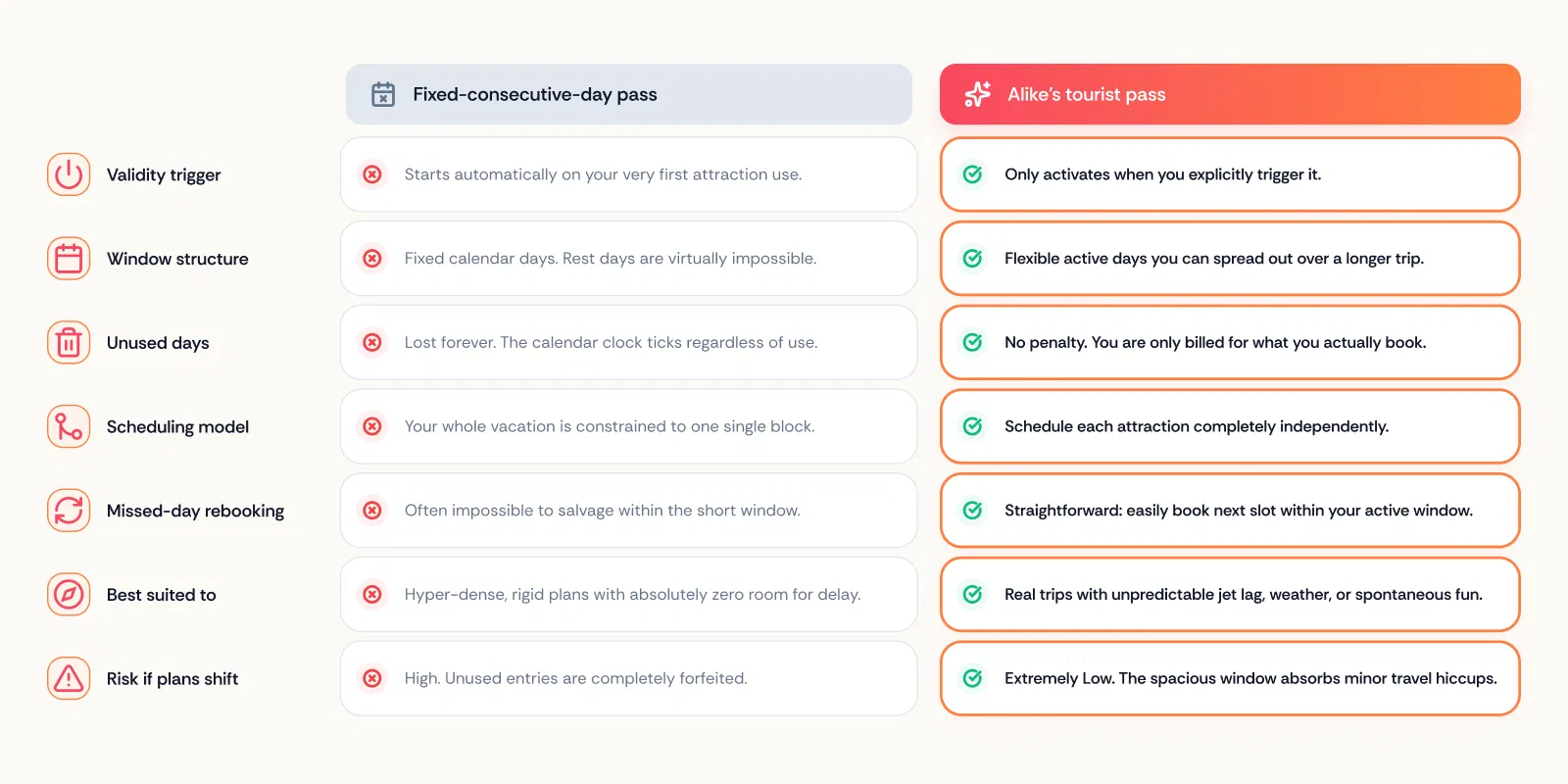
Fixed-consecutive-day model vs. Alike's flexible, independent-scheduling model
| Fixed-consecutive-day pass | Alike's tourist pass | |
|---|---|---|
| Validity trigger | Starts on first use | Starts on activation |
| Window structure | Fixed number of consecutive calendar days | Set number of days from activation, used flexibly within that period |
| Unused days | Lost: the clock runs regardless of use | No penalty: only used attractions are booked |
| Scheduling model | Whole pass tied to one fixed block | Each attraction scheduled independently |
| Rebooking after a missed day | Often not possible within the pass window | Straightforward: book the next available slot within the window |
| Best suited to | Short, tightly fixed itineraries unlikely to change | Trips with any uncertainty, jet lag, weather, flexible dates, longer stays |
| Risk if plans shift | High: days and entries can be forfeited | Low: the window absorbs most common disruptions |
The fixed-consecutive model isn't a worse product on its face. It's a simpler mechanic that works fine for a traveller whose schedule is locked and unlikely to move. The trade-off is that it has no give in it. Alike's model trades a small amount of that simplicity for a meaningfully larger margin of error, which matters more the longer or less predictable your trip is.
Traveller scenarios where this actually matters
Jet lag on arrival. You land after a long-haul flight planning to start sightseeing the next morning, but day one turns into a recovery day instead. On a fixed-consecutive pass, that's a day of validity spent doing nothing. On a flexible, independent-scheduling pass, you simply book your first attraction for day two or three instead, and the rest of the window is unaffected.
Weather disrupting an outdoor attraction. An open-top bus tour or an observation deck loses most of its appeal in heavy rain. With independent per-attraction scheduling, you can move that specific booking to a clearer day later in your window without touching anything else on the pass. A fixed-consecutive pass gives you no such option. The day either gets used as planned or it's wasted.
Extending a trip last-minute. Plans change: a cheaper return flight becomes available a few days later, or a work commitment gets pushed back and suddenly there's more time in the destination. A longer window comfortably absorbs a few extra days without needing to buy anything new. A fixed 3- or 5-day pass activated early in the trip will likely have already expired by the time the extension becomes real.
Splitting attractions across a longer stay. Some travellers deliberately don't want to sightsee every day, a week-long trip might mean three attraction days and four days doing something else entirely: business meetings, visiting family, or simply resting. Independent scheduling lets you place those three attraction days wherever they fall naturally across the window, rather than forcing them into a consecutive block that doesn't match how the rest of the trip is structured.
In each of these scenarios, the cost of inflexibility is concrete: a specific attraction you paid for and didn't get to use, or a day of validity spent on nothing because the schedule didn't move when the trip did.
Where flexibility fits into choosing a pass
Flexibility is one factor among several worth checking before you buy, alongside how many attractions you're realistically going to visit and whether any of them need their own timed-entry booking regardless of the pass. If you're still deciding whether a pass makes sense for your trip at all, Who Should Buy a Tourist Pass (and Who Shouldn't) is the right place to start. If you've already decided a pass is right for you and want to avoid the most common buying errors, including sizing a pass for more attractions than you'll actually use, see Tourist Pass Buying Mistakes to Avoid.
Validity windows also interact with how much a pass saves you. A flexible window that lets you comfortably fit in an extra attraction you'd otherwise have skipped can shift the maths in your favour. For the full breakdown of how multi-attraction pricing and savings scale, see How Tourist Pass Savings Work.
This is also where Alike's model naturally fits into a buying decision: a longer window with independently scheduled attractions is built specifically for travellers who want the savings of a pass without accepting the rigidity of a fixed multi-day block. If your itinerary has any uncertainty in it at all, and most real trips do, that structural difference is worth weighing before you compare prices.
Related reading
Keep planning
If flexibility is the deciding factor for your trip, the next useful step is checking whether a pass makes financial sense for your specific attraction list. See How Tourist Pass Savings Work for the maths, and Tourist Pass Buying Mistakes to Avoid for the checks worth doing before you commit. When you're ready to build a list of attractions for a specific destination, Alike's tourist passes let you choose only what you plan to visit and schedule each one independently within your validity window, whether that's London, Dubai, Melbourne or Sydney.
Frequently Asked Questions (FAQ)
Are tourist passes flexible?
Are tourist passes flexible?
What does "validity window" mean for a tourist pass?
What does "validity window" mean for a tourist pass?
Can I skip a day on my tourist pass without losing it?
Can I skip a day on my tourist pass without losing it?
Does a longer validity window mean I have to visit an attraction every day?
Does a longer validity window mean I have to visit an attraction every day?
What happens if my flight is delayed and I miss a booked attraction slot?
What happens if my flight is delayed and I miss a booked attraction slot?
Is a longer validity window always better than a shorter, cheaper one?
Is a longer validity window always better than a shorter, cheaper one?